
Why Brand Guidelines Matter in Product Label Design?
Blog post descA product label does more than identify what's inside a container—it communicates trust, quality, and brand recognition. As product lines grow, maintaining consistency across packaging becomes essential. In this article, we explore how brand guidelines help create cohesive packaging systems, using the NaturaSet rebranding project as a real-world example. Discover how a structured visual system can transform individual products into a recognizable brand family while simplifying future product development and strengthening shelf presence. Explore the full NaturaSet branding and packaging case study: https://www.behance.net/gallery/245301011/NaturaSet-Brand-Identity-Packaging-System #packagingdesign #labeldesign #branding #brandidentity #graphicdesign #productpackaging #brandguidelines #industrialdesign #marketingdesign #manteghstudioription.
BRANDING
Walk down the aisle of any hardware store, supermarket, or pharmacy, and you'll notice something interesting. The strongest brands are rarely recognized by a single product. Instead, they're recognized by a family of products that share a visual language.
This is where brand guidelines become one of the most valuable tools in packaging and label design.
Many companies approach product labeling one product at a time. A new coating, a new adhesive, or a new waterproofing solution is developed, and a label is created independently. While this may seem practical, it often leads to a fragmented product line that lacks consistency, weakens brand recognition, and creates confusion for customers.
A successful product family behaves differently. Every package, label, container, and marketing piece speaks the same visual language while still allowing each product to maintain its own identity.
Why Should Product Labels Never Be Designed in Isolation?
The Challenge of Growing Product Lines
As companies expand, their product offerings become more diverse. Different applications, formulas, colours, and performance levels need to be communicated clearly to customers.
Without a brand system, product labels often become disconnected from one another. Different colours, layouts, typography choices, and graphic styles create the impression that products belong to different manufacturers, even when they come from the same company.
This inconsistency can reduce customer confidence and make product selection more difficult.
A well-developed brand guideline solves this problem by establishing rules that every future product can follow.
Creating a Visual Family
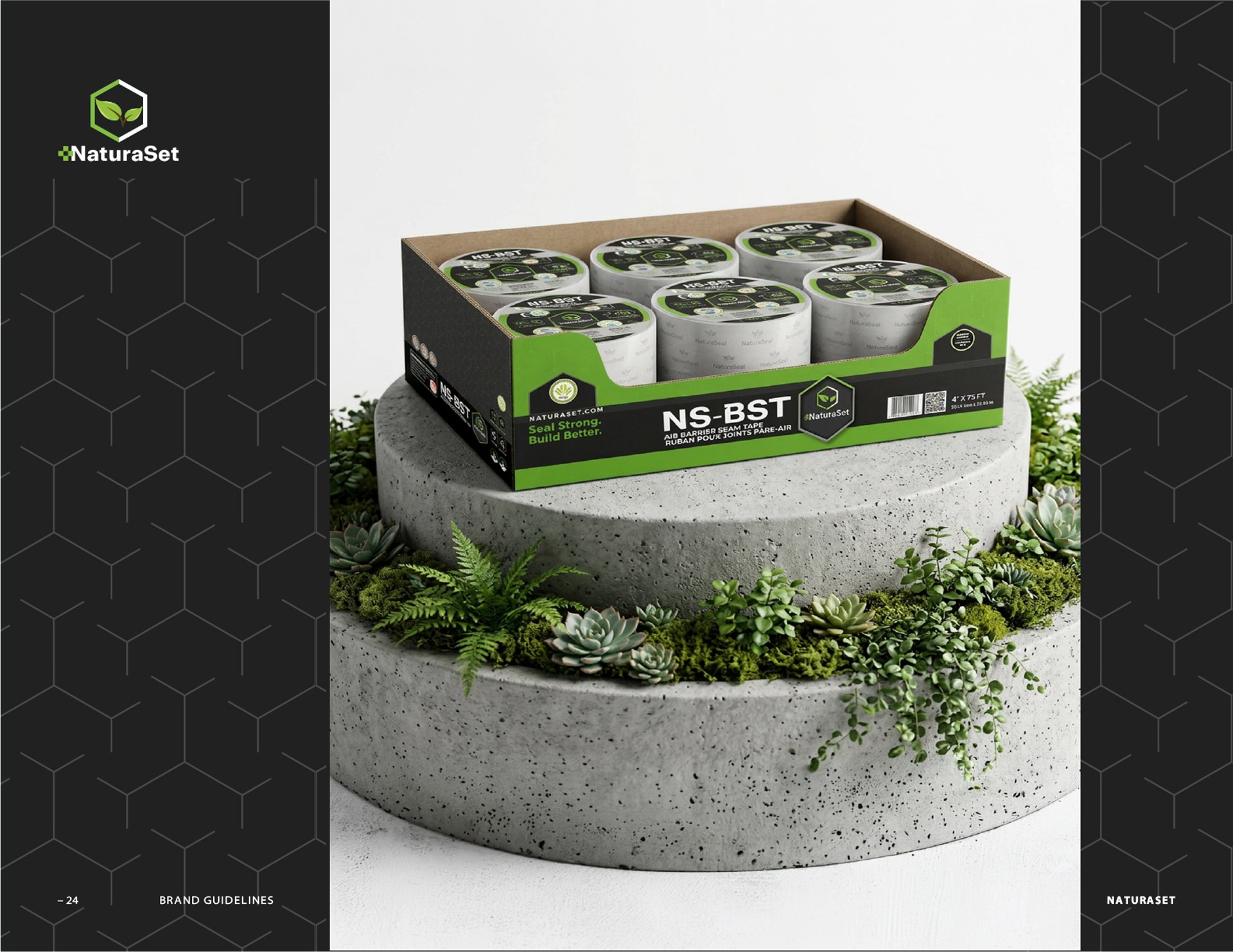
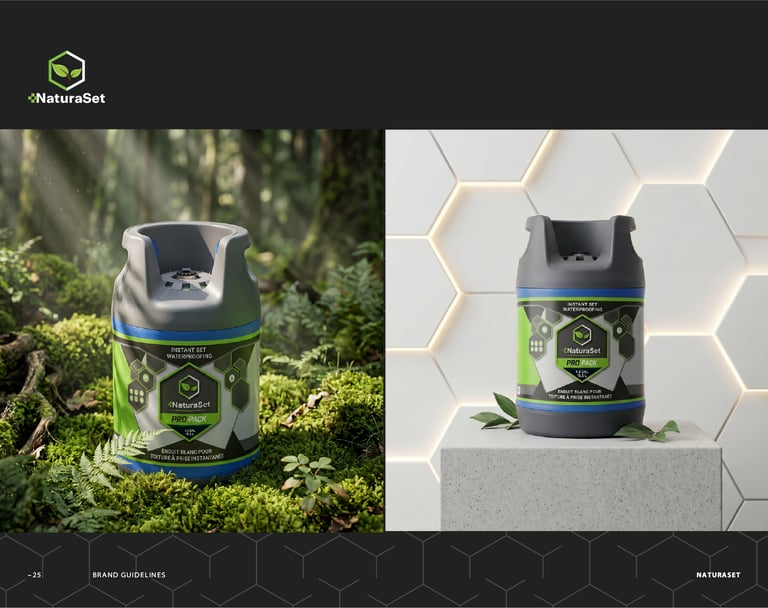
One of the recent projects at Mantegh Studio involved the rebranding and packaging development for Naturaseal.
The objective was not simply to redesign a logo or create a single label. The larger challenge was to create a system capable of supporting multiple product categories while maintaining a consistent identity.
The design system established several key elements:
Consistent logo placement
Unified typography hierarchy
Repeating geometric visual elements
Standardized information zones
Shared iconography
Consistent material and finish recommendations
Colour-coded product categories
This approach allows customers to instantly recognize the brand while quickly identifying the specific product they need.
For example, Foundation Waterproofing may use a blue colour system, Roof Repair may use green, and Re-Roof Coating may use white. Despite the different colours, the products still feel like members of the same family because the underlying design framework remains consistent.
Why Brand Guidelines Matter
A brand guideline is often misunderstood as a document that only explains logo usage.
In reality, it serves as a blueprint for every future design decision.
When properly developed, a guideline can answer questions such as:
Where should product names appear?
How should technical information be organized?
Which fonts should be used?
How should product categories be differentiated?
Which colours belong to each product family?
What visual elements should remain consistent across all packaging?
The result is faster design development, improved quality control, and a stronger brand presence in the marketplace.
Recognition Happens Faster Than Reading
Most purchasing decisions begin before a customer reads a single word.
People identify products through colour, shape, layout, and visual familiarity. Strong branding creates recognition from several feet away.
When every label follows the same design system, customers can quickly understand:
"This belongs to the same company."
"This is part of the same product family."
"This is the product category I need."
That level of recognition is difficult to achieve when labels are designed independently.
Building for the Future
One of the biggest advantages of a structured packaging system is scalability.
Today a company may have three products. Tomorrow it may have thirty.
When a strong guideline exists, future products can be introduced without reinventing the design process each time. New labels inherit the same visual DNA, preserving consistency while reducing development costs.
The strongest brands are not built product by product. They are built system by system.
A well-designed label does more than communicate information. It reinforces trust, strengthens recognition, and helps every product contribute to a larger brand story.
For companies planning to expand their product lines, investing in a clear brand guideline is not an optional design exercise—it is a strategic business decision that continues to pay dividends long after the first product reaches the shelf.
See the Full Branding and Packaging System
Creating a successful product label involves much more than placing a logo on a container. Every decision—from typography and color coding to information hierarchy and packaging architecture—contributes to a cohesive brand experience.
The NaturaSet project demonstrates how a structured brand guideline can be translated into a complete packaging system that supports multiple products while maintaining a unified visual identity.
To explore the complete branding process, packaging development, label design system, mockups, and final applications, visit the full case study:
NaturaSet Brand Identity & Packaging System Case Study
At Mantegh Studio, we help companies develop scalable brand systems that ensure every product, package, and customer touchpoint works together as part of a larger visual family.
Specialists
Enhancing your brand with tailored marketing solutions.
Connect
info@manteghstudio.com
+1(647) 707-3242
Design by: Mantegh Studio Inc.
All rights reserved © 2026 - Mantegh Studio Inc.
What We do ?
Branding
Brand Positioning
Art Direction
Naming
Content Creation
Mural Design
Print Management